Note
This page used to be hosted at https://effectivebehaviorchange.com (and https://effectievegedragsverandering.nl).
A basic introduction
A useful overview of how behavior change actually works, an excerpt from a Greater Good training, is available here. Where that overview is a bit more complete, this figure summarizes the dynamics of behavior change with a focus on the change processes.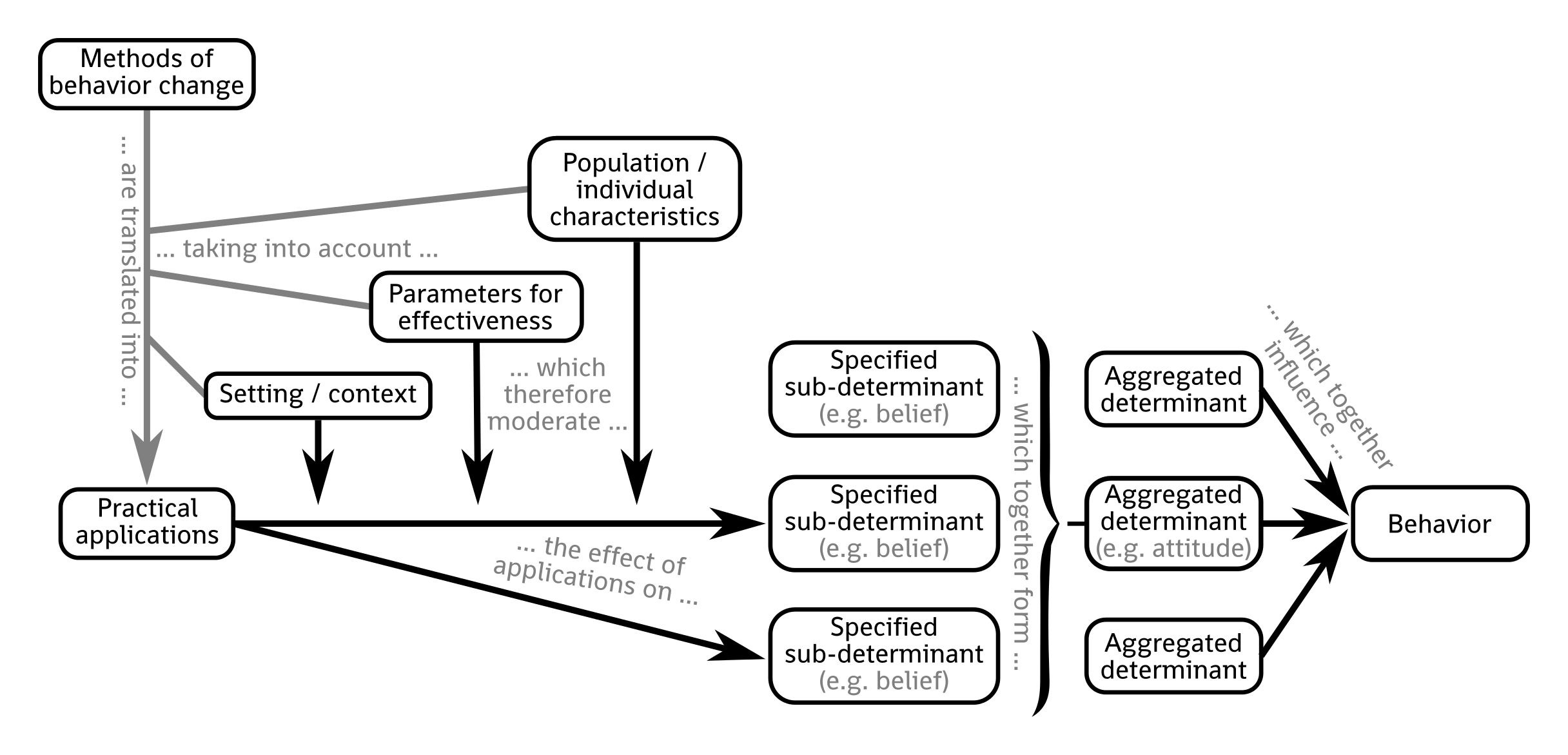
The elements in these overviews, the basics of effective behavior change, are explained in two introductory articles:
- Peters, G.-J. Y. (2014). A practical guide to effective behavior change: How to identify what to change in the first place. European Health Psychologist, 16(5), 142-155.
- Crutzen, R. Peters, G.-J. Y. & Noijen, J. (2017). How to Select Relevant Social-Cognitive Determinants and Use them in the Development of Behaviour Change Interventions? Introducing Confidence Interval-Based Estimation of Relevance PsyArXiv.
- Kok, G. (2014). A practical guide to effective behavior change: How to apply theory- and evidence-based behavior change methods in an intervention. European Health Psychologist, 16(5), 156-170.
- Kok, G., Gottlieb, N. H., Peters, G.-J. Y., Mullen, P. D., Parcel, G. S., Ruiter, R. A. C., Fernández, M. E., Markham, C., & Bartholomew, L. K. (2015). A Taxonomy of Behavior Change Methods; an Intervention Mapping Approach. Health Psychology Review. DOI: 10.1080/17437199.2015.1077155
Recorded presentations
A number of mini-lectures about understanding the behavior you want to change are available at: These mini-lectures focus on step 2 of Intervention Mapping. Intervention Mapping (see Wikipedia) is a protocol for developing theory-based and evidence-based health-promotion programs. If you mean to get involved with behavior change, it provides an excellent framework that helps you to ask yourself the right questions and find the answers to those questions.This is an antichronologically ordered list of recorded lectures about behavior change.
-
Program Design (Behavior Change Methods & Applications)
Brief lecture in the Intervention mapping Summer School 2018, Maastricht, the Netherlands, at Wednesday the 11th of July, 2018. -
Program Design (Behavior Change Methods & Applications)
Brief lecture in the Intervention mapping Summer School 2017, Maastricht, the Netherlands, at Wednesday the 12th of July, 2017. -
Program Design (Behavior Change Methods & Applications)
Lecture in two master courses at Maastricht University, Friday the 25th of November, 2016. -
Program Design (Behavior Change Methods & Applications)
Presentation held at the Intervention Mapping Summer School 2015, Maastricht, the Netherlands. A version hosted at Youtube
This approach compared to the BCT taxonomy
Recently, a debate erupted in the community of behavior change researchers. The debate started when a paper in Health Psychology Review (a journal of the European Health Psychology Society that published reviews, meta-analyses and theoretical papers) pointed out a number of problems with using the BCT taxonomies originally proposed by Abraham and Michie (2008) to determine behavior change method effectiveness through meta-analysis. The original paper where these taxonomies were proposed is available through the Department of Health Promotion and Development at the University of Bergen:- Abraham, C. & Michie, S. (2008) A Taxonomy of Behavior Change Techniques Used in Interventions. Health Psychology, 27(3), 379-387.
- Peters, G.-J. Y. (2015). IM’s Methods of Behavior Change and the Behavior Change Techniques (BCTs). Presentation held at the Intervention Mapping Summer School 2015, Maastricht, the Netherlands.
- Peters, G.-J. Y., de Bruin, M. & Crutzen, R. (2015). Everything should be as simple as possible, but no simpler: towards a protocol for accumulating evidence regarding the active content of health behaviour change interventions. Health Psychology Review, 9(1), 1-14.
- Field, Johnson, Michie, Johnston, Armitage, Knittle, de Bruin, Crutzen & Peters (2015). Various comments to this article and the authors’ response to these comments Health Psychology Review, 9(1), 14-41. (Note that none of these are open access, unfortunately.)
Influencing environments and organisations
There’s a very useful paper about stakeholder theory that is self-archived on Researchgate:
-
Kok, G., Gurabardhi, Z., Gottlieb, N. H., & Zijlstra, F. R. (2015). Influencing Organizations to Promote Health Applying Stakeholder Theory. Health Education & Behavior, 42(1 suppl), 123S-132S.
Broadening your view
The two Practical Guides to Effective Behavior Change linked to above are part of a special issue, which also contains a number of more in-depth articles, which you might want to get into if you are already familiar with behavior change, or if you are more interested in doing research:- Silva, M. N., Marques, M. M., Teixeira, P. J. (2014). Testing theory in practice: The example of self-determination theory-based interventions . European Health Psychologist, 16(5), 171-180.
- Johnston, M. (2014). Improving the reporting of behaviour change interventions. European Health Psychologist, 16(5), 181-189.
- Knittle, K. (2014). Fidelity in intervention delivery: A rough field guide. European Health Psychologist, 16(5), 190-195.
- Naughton, F. & Johnston, D. (2014). A starter kit for undertaking n-of-1 trials . European Health Psychologist, 16(5), 196-205.
- Hagger, M. S. & Luszczynska, A. (2014). Planning interventions for behaviour change: A protocol for establishing best practice through consensus. European Health Psychologist, 16(5), 206-213.
The complete table of contents is available as well.
If you have any questions, or better yet, freely accessible resources to link to, you can contact me through https://behaviorchange.eu.